
Introduction
Most startups don’t struggle with SEO because they lack tools or the Best SEO Tools. They struggle because they rely on tools without a system behind them.
Search for “best SEO tools” and you’ll find endless lists comparing features, dashboards, and pricing tiers. But more tools don’t produce better results. A clear process does.
Platforms like SEMrush and Ahrefs are genuinely powerful. But without a coherent strategy, they tend to become sources of noise rather than clarity. This guide covers the best SEO tools available today, how to actually use them, and how to build a system that connects SEO work to real business outcomes.
What Are SEO Tools?
SEO tools are platforms that help businesses analyze search demand, identify keyword opportunities, audit website performance, optimize content, and track rankings over time.
They provide data. But they don’t provide direction. And that distinction is where most startups lose their way.
Why Most Startups Use SEO Tools Wrong
The typical pattern looks like this: install multiple tools, track hundreds of keywords, publish content inconsistently, and measure traffic instead of outcomes. The result is activity without progress.
The problem is rarely the tools themselves. But rather It’s the absence of a structured system that connects business goals to content strategy to SEO execution. Without that connection, even the best SEO tools produce reports that don’t translate into growth.
Best SEO Tools by Function
Rather than searching for one tool that does everything, the more useful approach is building a stack where each tool has a defined role.
SEMrush: Best for Keyword and Competitive Research
Best for identifying opportunities and understanding what competitors are doing.
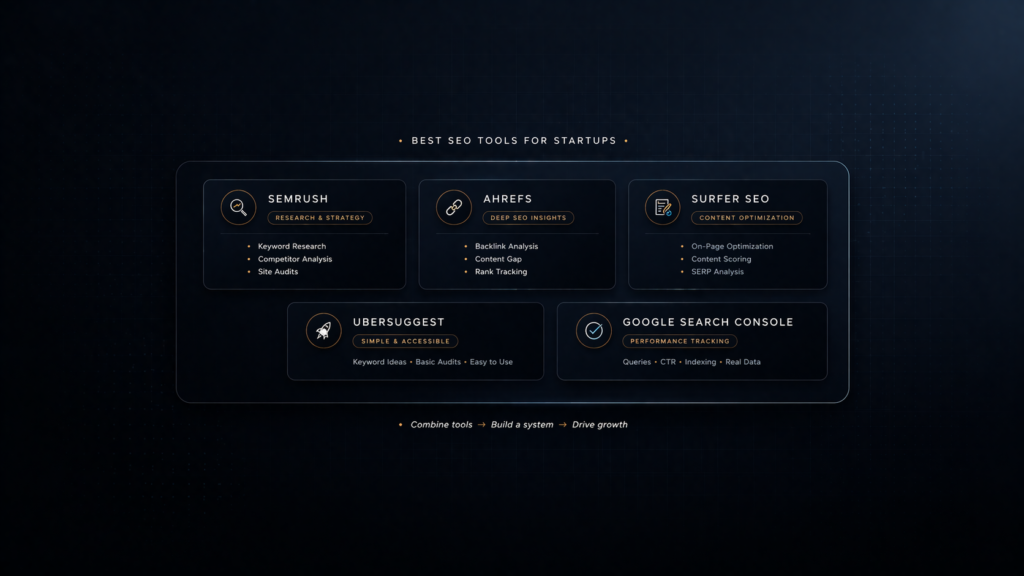
SEMrush covers keyword research, competitor analysis, site audits, and backlink tracking. It is one of the most comprehensive SEO tools available for startups that want to understand their market before committing to a content direction.
Explore SEMrush to identify structured growth opportunities.
Ahrefs: Best for Deep SEO Analysis
Best for investors in organic growth who need advanced SEO intelligence.
Ahrefs is particularly strong on backlink analysis, content gap identification, and keyword tracking. Where SEMrush gives you breadth, Ahrefs tends to give you depth. Used together, they cover most of what a serious SEO process requires.
Explore Ahrefs for deeper competitive and content insights.
Surfer SEO: Best for Content Optimization
Best for structuring individual pieces of content to rank.
Surfer SEO works at the content level rather than the strategy level. It helps with on-page optimization, content scoring, and SERP analysis, making it useful once you already know what to write and need to structure it for search intent.
Explore Surfer SEO to improve content performance.
Ubersuggest: Best for Early-Stage Startups
Best for founders who are just starting to build an SEO foundation.
Ubersuggest offers keyword research, basic site audits, and a simpler interface than the more advanced platforms. It is a reasonable entry point for startups that aren’t yet ready to invest in SEMrush or Ahrefs but want to move beyond guesswork.
Explore Ubersuggest for accessible SEO insights.
Google Search Console: The Non-Negotiable Foundation
Best for understanding what is actually happening with your search performance.
Google Search Console shows real search queries, click-through rates, and indexing issues. It is free, and it is not optional. Every other SEO tool you use should be interpreted alongside what Search Console tells you about actual performance.
How to Combine the Best SEO Tools Effectively
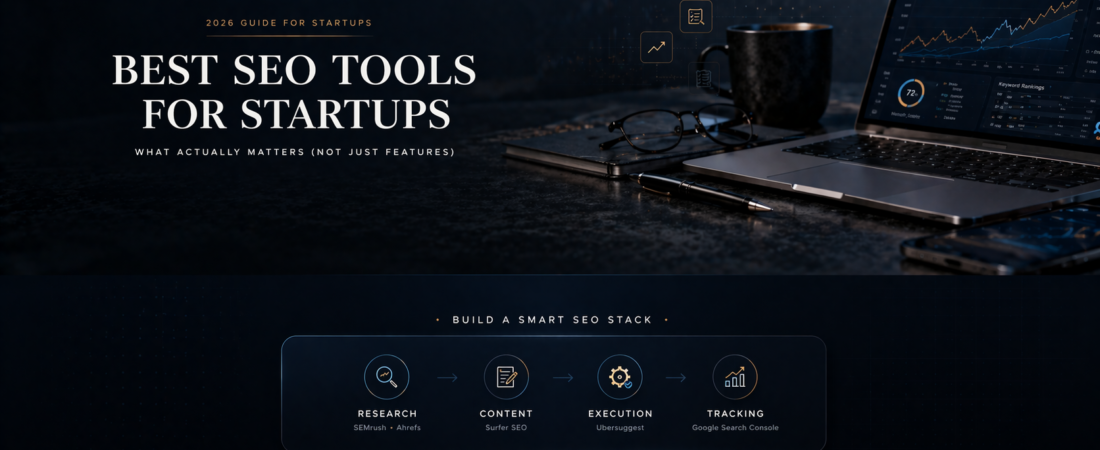
The real advantage of the best SEO tools comes not from using them in isolation but from connecting them into a coherent workflow. A practical structure looks like this: SEMrush for research and strategy, Ahrefs for validation and backlink analysis, Surfer SEO for content structure, and Google Search Console for performance tracking. This transforms a collection of tools into a decision-making framework.
How to Build an SEO System That Actually Works using the Best SEO Tools
Most startup founders focus on tools when they should be focusing on process. A structured SEO system has four components.
The first is opportunity identification: using tools like SEMrush to find keywords with real intent, market gaps worth addressing, and content opportunities connected to what your audience is actually searching for.
The second is content strategy: defining which topics to cover, how they relate to each other, and what business outcome each piece of content is meant to serve. Without this layer, SEO becomes content production without purpose.
The third is content execution: using tools like Surfer SEO to structure articles and optimize for search intent, ensuring that what gets published actually has a chance of ranking.
The fourth is performance tracking: using Google Search Console to measure real outcomes and adjust strategy based on what the data shows. Not vanity metrics, but signals that connect to business goals.
This is what turns SEO into a growth system rather than a marketing activity.
Best SEO Tools vs Business Growth
This is where many founders get misled. SEO tools optimize keywords, pages, and rankings. But businesses grow through positioning, strategy, and conversion. So without alignment between SEO activity and business strategy, traffic does not translate into revenue. Visibility without direction is not an asset. It is a distraction.
When SEO and Best SEO Tools Becomes Critical
SEO tools and structured systems become genuinely important when a startup wants predictable inbound growth, is scaling content production, is building long-term market visibility, or is operating in a competitive space where organic search is a meaningful acquisition channel. At that stage, structure matters more than which specific tools you use.
Final Thought on Best SEO Tools
There is no single best SEO tool. There are only the right tools for your system and the clarity of the strategy behind them. The goal is not to use more tools. It is to make better decisions. Tools that don’t serve a clear process are not assets. They are overhead.
Next Steps
If you want to go beyond tools and build a structured approach to organic growth, explore how to align your website strategy with your SEO structure, or connect SEO to a broader business growth strategy.
What is the best SEO tool for startups?
There is no single answer. SEMrush and Ahrefs are strong for research and competitive analysis, while Surfer SEO helps optimize individual pieces of content. Most startups benefit from combining two or three tools rather than relying on one.
Are free SEO tools enough?
Google Search Console is free and essential. But for startups trying to grow in competitive markets, free tools alone rarely provide the depth needed for a structured SEO strategy.
How many SEO tools should a startup use?
Most startups only need two or three tools used consistently and with purpose, rather than a long list of platforms used poorly. Clarity of process matters more than the size of the stack.
Do SEO tools guarantee rankings?
No. SEO tools provide data and analytical support, but rankings depend on the quality of your strategy, the relevance of your content, and the consistency of your execution over time.