
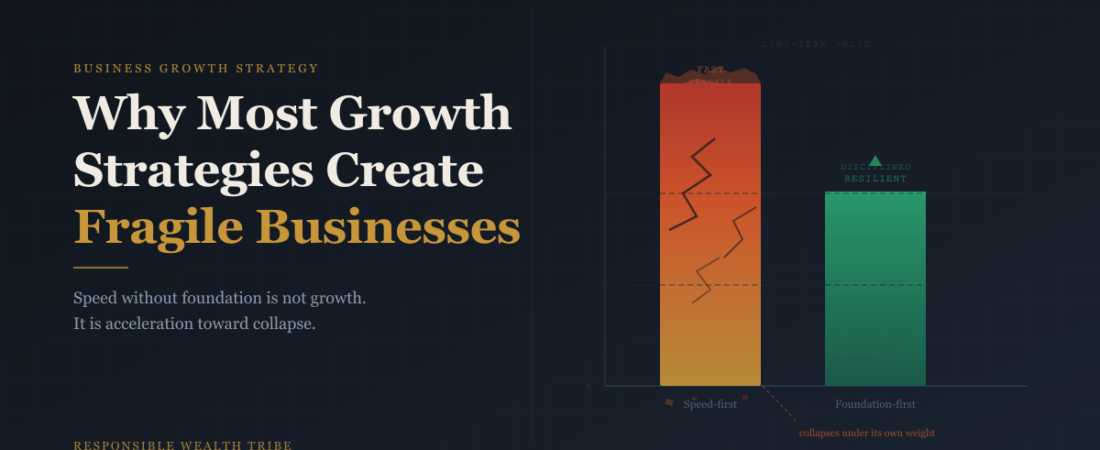
Growth is one of the most celebrated ideas in business and is the aim of almost any business growth strategy. Investors look for it. Founders chase it. Markets reward it.
Revenue growth, user growth, customer growth, geographic expansion, headcount growth. Wherever you look, growth tends to be treated as the ultimate measure of success.
And yet, a striking number of businesses collapse shortly after their fastest period of expansion. Some run out of cash. Others lose the customers they worked so hard to acquire. Others quietly fall apart through operational breakdowns, culture deterioration, or a sudden loss of investor confidence.
The problem is rarely growth itself. The problem is that most businesses pursue growth without first building the systems required to support it.
A business can survive slow growth. It rarely survives fragile growth indefinitely.
A responsible business growth strategy is not designed to maximize speed. It is designed to maximize long-term resilience.
1- Why Growth Has Become a Dangerous Business Obsession
Modern business culture celebrates growth without asking the question that actually matters: what kind of growth are we creating?
Founders are surrounded by stories of companies that expanded rapidly, raised massive funding rounds, or reached extraordinary valuations in a short period of time. Far less attention goes to the businesses that grew too quickly and later collapsed under the weight of their own complexity. Survivorship bias rarely makes the headlines.
This creates a dangerous distortion. Businesses begin optimizing the business growth strategy for what is visible: revenue growth, user growth, headcount growth, market expansion, fundraising announcements. Meanwhile, the less visible foundations that actually make growth sustainable get neglected: operational discipline, customer retention, cash flow management, team capability, capital efficiency.
As the investor Bill Gurley once put it, growth is a deceptive metric. It can disguise a structurally flawed business model for a long time, but it can never repair one.
Growth can hide weakness for a while. Eventually, that weakness becomes impossible to ignore.
2- Growth Is Not the Same as Scaling
One of the most common strategic mistakes is treating growth and scaling as though they were the same thing. They are not, and the difference matters more than most founders realize.
Growth means becoming larger. Revenue increases. Customers increase. Resources increase. But costs often rise at a similar pace. A consulting firm that doubles its revenue by doubling its workforce is growing. It is not necessarily becoming more efficient.
Scaling means becoming more efficient as the business expands. Revenue grows meaningfully faster than costs, because the business has developed systems, processes, and technology that create real operational leverage. This is part of why software businesses tend to scale more effectively than service businesses. Their infrastructure can absorb thousands of additional users with only a small increase in cost.
Sustainable growth is expansion the company can actually support. It happens within the limits of available resources, cash flow, and operational capability. A sustainable business grows at a pace it can realistically sustain, not the pace its ambition demands.
Durable growth is concerned with longevity rather than speed. It is protected by strong customer relationships, operational resilience, real competitive advantages, and disciplined capital allocation. Durable growth cares less about this quarter’s numbers and more about staying relevant and intact over decades. The strongest businesses tend to prioritize durability first, and let speed follow.
3- The Warning Signs of a Fragile Business Growth Strategy
Fragile growth using a fragile business growth strategy rarely looks fragile at first. In fact, it often looks impressive. Revenue rises. Customers increase. New markets open. The warning signs tend to live beneath the surface, where quarterly reports don’t usually look.
Customer acquisition costs keep rising. Growth becomes progressively more expensive, and the business has to spend more to acquire each additional customer. Once acquisition costs rise faster than customer value, growth becomes difficult to sustain, no matter how good the top-line numbers look.
Customer retention begins to decline. Many businesses pour their energy into acquisition while quietly neglecting retention. This sets off a familiar, dangerous cycle: acquire customers, lose customers, acquire more, lose more. From the outside, the business looks like it’s growing. In reality, it’s leaking value just as fast as it creates it.
Operational complexity outpaces capability. New products, new markets, new employees, new systems, new partnerships. Complexity is a natural byproduct of growth. The trouble starts when complexity grows faster than the organization’s ability to manage it.
Team burnout increases. Growth places real pressure on people, and when systems are weak, teams compensate through sheer effort. Hours get longer. Processes become reactive. Decision-making quality drops. Eventually, the best people leave, taking institutional knowledge with them that is rarely easy to replace.
Margins begin shrinking. Plenty of businesses celebrate rising revenue while quietly ignoring falling profitability. A bigger business with weaker margins is not automatically a stronger business. In some cases, it’s considerably more fragile than it was before it grew.
Customer experience declines. Support requests pile up. Response times slow. Delivery quality slips. Negative reviews accumulate. Trust starts to erode, and growth without customer satisfaction eventually becomes self-defeating.
Many growth challenges originate from structural weaknesses rather than market conditions. If you’re evaluating your company’s growth systems, explore our Business Growth Strategy advisory services.
4- The Hidden Costs of Growing Too Fast
Rapid expansion often creates a kind of organizational debt. It stays invisible until it becomes a serious problem, and by then, the costs have usually compounded.
4-1. Culture Deterioration
Culture is often the first casualty of uncontrolled growth. When growth outpaces organizational capability, communication breaks down, hiring standards quietly slip, accountability weakens, and teams shift from executing a strategy to firefighting preventable problems.
David Packard argued, decades ago, that a business can only grow as fast as it can recruit, train, and retain the right people. Human capability sets a natural speed limit on growth. Ignore that limit, and instability follows.
4-2. Customer Trust Erosion
A business can spend years earning trust and lose most of it in a matter of months. When operational systems become overwhelmed, product quality declines, support delays increase, and delivery performance suffers. Customer frustration grows right alongside the revenue chart.
Revenue may keep climbing for a while. Loyalty usually doesn’t. Eventually the consequences show up as churn, negative reviews, reputational damage, and fewer referrals. Trust, once lost, is genuinely difficult to rebuild.
4-3. Profitability Compression
Growth does not automatically improve profitability. Undisciplined growth often destroys it. Under growth pressure, companies tend to increase marketing spend, hire aggressively, expand product lines, and enter new markets before they’re ready. Each of those decisions adds cost and complexity.
Without a business growth strategy that focuses on real operational leverage behind growth, profitability deteriorates, and the business becomes increasingly dependent on outside capital just to keep functioning.
4-4. Fundraising Challenges
Many founders assume growth automatically attracts investment. Investors tend to see it differently. Early-stage investors may tolerate some inefficiency. Later-stage investors and institutional capital providers generally will not. They look deeper, examining retention, unit economics, cash flow, capital efficiency, and governance.
A company with impressive growth but weak fundamentals can struggle to raise capital, even with strong top-line metrics to show for itself.
5- What Investors See That Founders Often Miss
Founders naturally focus on opportunity. Investors focus on risk. That difference in perspective explains a lot of the tension between the two.
While founders celebrate rapid expansion, investors are usually asking a quieter question: can this growth survive pressure? In answering it, they tend to evaluate a few specific things.
Customer retention signals whether customers genuinely value the product, beyond the initial acquisition push. Strong retention is one of the better predictors of long-term resilience.
Capital efficiency asks how much capital it actually takes to generate growth. Businesses that depend on a constant stream of external funding are often more fragile than their growth charts suggest.
Cash flow matters even more than revenue. Many businesses fail despite growing sales, simply because they can’t generate enough cash to support day-to-day operations.
Operational discipline asks whether the organization can execute consistently, scale without descending into chaos, and allocate resources responsibly. These questions, more often than not, matter more than the short-term growth rate.
Preparing for growth and preparing for capital are often the same challenge. Explore our Capital Readiness framework to strengthen your business before pursuing expansion or fundraising.
6- Businesses That Chose Resilience Over Speed
Not every successful company chased aggressive growth. Some deliberately slowed down to build stronger foundations first.
Zapier raised relatively little outside capital compared to many of its venture-backed competitors. Rather than using funding to accelerate aggressively, the company focused on profitability and operational efficiency. The result is a highly scalable business with strong economics and a level of resilience that’s hard to manufacture under pressure.
Basecamp became something of a case study in rejecting traditional startup growth expectations. Instead of maximizing headcount and expansion speed, the company prioritized focus, simplicity, and profitability. More than two decades later, it remains a respected example of what disciplined growth can look like.
Buffer initially pursued venture-backed growth, the conventional path. Eventually, leadership recognized the costs that path was creating, and chose to slow down, buy out investors, and refocus on sustainable operations. That decision strengthened the company’s culture, its financial footing, and its long-term resilience.
Kit, formerly ConvertKit, took a narrower path rather than chasing broad market expansion. The company concentrated on serving creators exceptionally well. That disciplined positioning improved retention, lowered acquisition costs, and supported growth that was actually profitable.
7- What a Responsible Business Growth Strategy Looks Like
Growth becomes far less risky once it’s supported by a strong foundation. At Responsible Wealth Tribe, we treat growth as a consequence of disciplined systems, not an objective worth pursuing at any cost. In practice, a responsible business growth strategy tends to follow six principles.
1. Build before scaling. Fix operational weaknesses before increasing demand. Scaling has a way of amplifying strengths and weaknesses equally.
2. Protect unit economics. Growth should improve your economics over time, not erode them. A larger business with poor unit economics is simply a larger problem.
3. Grow within operational capacity. Expansion should stay aligned with what the organization can actually execute. Growth should challenge your systems, not overwhelm them.
4. Prioritize retention. Keeping a customer is often more valuable than acquiring a new one. Strong retention is what makes growth durable rather than temporary.
5. Allocate capital deliberately. Capital should solve strategic problems, not paper over structural weaknesses. As William Thorndike has argued, capital allocation is one of leadership’s most consequential responsibilities, and it deserves to be treated that way.
6. Design for durability. The objective was never rapid growth for its own sake. The objective is long-term value creation. Durable businesses can survive market cycles, economic shocks, and competitive pressure. Fragile ones cannot.
8- Final Thought
Most growth strategies fail for the same underlying reason: they prioritize expansion before foundation, treating growth as an objective rather than an outcome.
But growth does not create resilience. Resilience creates sustainable growth. A business can survive slower growth. It can recover from a missed opportunity. It can adapt to changing conditions. What it often cannot survive is growth that outpaces its own ability to support it.
If you’re building something meant to last, the quality of your growth strategy matters more than its speed.
9- About Responsible Wealth Tribe
Responsible Wealth Tribe supports founders, investors, and organizations through strategic advisory focused on business growth strategy, capital readiness, fundraising strategy, capital structuring, and long-term value creation.
Build stronger before you build bigger.
Related Pages
Book A Discovery Call with Our Founder and Senior Consultant